

.svg)



News
Stark Raving Health Launches Ignite HCP, a Specialized HCP Activation Solution Purpose-Built for Clinical Trial Patient Recruitment


How clinical trial teams are using Meta, TikTok, and Reddit ads to recruit participants — and where IRB approval slows the process down. A look at platform policies, compliance challenges, and the realities of modern patient recruitment.
Social media is still one of the fastest ways to scale patient recruitment — and one of the fastest ways to burn through budget if the strategy is wrong.
A strong Meta campaign can put a study in front of hundreds of thousands of potential patients within days. A weak campaign usually produces the same underperforming and disappointing pattern: broad clicks, low-quality referrals, poor pre-screener completion rates, and ad creative stuck in compliance review halfway through launch.
Most failed campaigns come down to the same issues:
The platforms themselves matter too. Meta, TikTok, and Reddit all behave differently. Different audiences. Different trust dynamics. Different creative expectations. A campaign that performs well on Meta will usually fail on TikTok without major changes.
This guide breaks down where each platform works best, where it struggles, and what clinical trial teams tend to underestimate before launch.
No platform works for every study.
A national Type 2 diabetes trial and a rare oncology study should not run the same social strategy. The audience behavior is different, the patient journey is different, and the way people engage with health content varies dramatically across platforms.
Meta remains the default social platform for clinical trial recruitment for one simple reason: volume.
No other social platform offers the same combination of scale, geographic targeting, caregiver reach, and conversion infrastructure. For studies targeting adults 40+, it’s usually the first place media budgets go.
That said, Meta has become harder to manage over the last few years.
Healthcare targeting restrictions are tighter. Users are more ad-aware. And Meta’s automation tools increasingly optimize for engagement rather than qualified referrals unless campaigns are watched carefully.
Meta still performs especially well for:
Facebook remains unusually strong for caregiver outreach. In many studies, especially Alzheimer’s or advanced disease indications, the caregiver is effectively the decision-maker. That audience is much easier to reach on Meta than on any other social platform.
Lead generation ads are another major advantage.
Keeping pre-screeners inside Facebook or Instagram almost always improves completion rates compared to sending patients to a separate landing page. Fewer drop-offs. Less friction. Better mobile performance.
The biggest mistake teams make is over-targeting.
Meta no longer allows advertisers to directly target many health-condition categories. That means campaigns have to rely on adjacent interests, behavioral patterns, broader demographics, and algorithmic optimization.
When campaigns aren’t monitored closely, Meta’s delivery system often drifts toward people who click frequently rather than people likely to qualify.
A campaign can look healthy on paper while generating almost no usable referrals.
Creative fatigue is another issue. Static ads that run too long usually collapse in performance. Meta rewards fresh creative, especially video.
And healthcare compliance adds another layer entirely. Ads need to pass both IRB review and Meta’s healthcare policy review — and the two are not always aligned.
An ad approved by the IRB can still get rejected by Meta.
In practice, the strongest-performing Meta campaigns tend to use:
The more the ad feels like a real person explaining participation, the better it usually performs.
TikTok is not a mature clinical trial recruitment platform yet. But it’s becoming increasingly important for certain indications, especially conditions with large patient communities already active on the app.
People openly discuss diagnosis experiences, medication side effects, chronic illness, fertility, ADHD, autoimmune disease, mental health, and rare conditions on TikTok in a way that doesn’t happen on most other platforms.
That context matters.
Patients already consuming condition-related content are far more likely to stop and engage with educational trial messaging than users casually scrolling Facebook.
TikTok tends to work best for:
The platform is much weaker for older demographics unless caregiver recruitment is part of the strategy.
Most Meta creative performs badly on TikTok.
Polished patient recruitment ads usually feel out of place immediately. TikTok users respond better to content that feels educational, direct, and informal.
Simple videos consistently outperform heavily branded production.
A study coordinator speaking directly to the camera often performs better than an highly-produced video shoot. That surprises sponsors more often than it should.
The first few seconds matter more than anywhere else. If the video feels promotional immediately, users scroll.
Captions matter too. A large percentage of TikTok users watch without sound, so the message has to work visually and textually at the same time.
TikTok’s healthcare advertising policies are still evolving, and enforcement can be inconsistent.
Some campaigns move through review quickly. Others get repeatedly flagged despite using nearly identical language.
That unpredictability makes TikTok harder operationally than Meta, especially for tightly timed enrollment windows.
Video also complicates IRB review. Scripts, captions, spoken claims, visuals, and on-screen text all require approval. Small creative changes can trigger additional review cycles that delay launch.
Reddit is not a scale platform. It’s a precision platform.
For certain clinical studies — especially those involving rare disease and chronic condition recruitment — Reddit can outperform much larger channels in terms of referral quality.
The reason is simple: patients on Reddit are usually there intentionally.
They’re researching treatments. Comparing experiences. Asking questions. Looking for information they can’t get elsewhere. Many are already aware of clinical research before they ever see an ad.
That creates a very different recruitment environment than entertainment-first platforms.
Reddit performs especially well for:
Condition-specific subreddits can be surprisingly concentrated audiences. In some rare disease categories, they’re one of the only meaningful online patient communities available.
The fastest way to fail on Reddit is sounding like an ad.
Reddit users are extremely skeptical of corporate messaging. Overproduced creative and marketing-heavy copy tends to get ignored immediately — or worse, openly criticized in comments.
Campaigns perform better when they acknowledge patient concerns directly:
Reddit audiences tend to ask harder questions than users on other platforms. Teams need a moderation plan before campaigns launch.
The tradeoff is reach.
Reddit usually cannot generate the raw referral volume needed for large national studies by itself. It works best as part of a broader media mix — especially alongside Meta or paid search campaigns.
But for niche patient recruitment, it can be disproportionately effective.
This is where many campaigns fall apart.
The FDA considers recruitment advertising part of the informed consent process. That means every patient-facing recruitment asset requires IRB review before launch.
Not just the primary ad.
Everything:
One of the most common mistakes in clinical trial advertising is submitting only a single creative version for approval and then trying to iterate later.
That almost always slows campaigns down.
The biggest delays usually come from:
Meta and TikTok add another complication: platform review.
Even after IRB approval, ads can still get rejected internally by the platform for healthcare policy reasons.
That review process is unpredictable enough that experienced patient recruitment teams build time for it into launch planning from the beginning.
The smoothest campaigns usually front-load approval work aggressively.
Instead of submitting one ad at a time, experienced teams submit:
The goal is to avoid additional review cycles later.
A strong IRB submission package protects launch timelines more than almost anything else in social recruitment.
The biggest mindset shift in using social media for patient recruitment is understanding that clinical trial targeting is not traditional marketing targeting.
The goal is not just reaching the right demographic.
It’s reaching patients who are realistically likely to qualify and participate.
That usually means combining:
For many indications, caregivers are the real audience.
That’s especially true for:
Meta remains the strongest caregiver platform by far.
Campaigns built specifically for caregiver concerns often outperform patient-directed messaging completely.
A medically qualified patient who lives four hours from a research site is unlikely to enroll.
Geographic targeting should reflect actual site capacity and enrollment goals — not evenly distributed national spend.
This sounds obvious, but many campaigns still waste budget driving interest in areas with little or no enrollment infrastructure.
The best social recruitment campaigns are rarely the flashiest.
They’re usually the campaigns that:
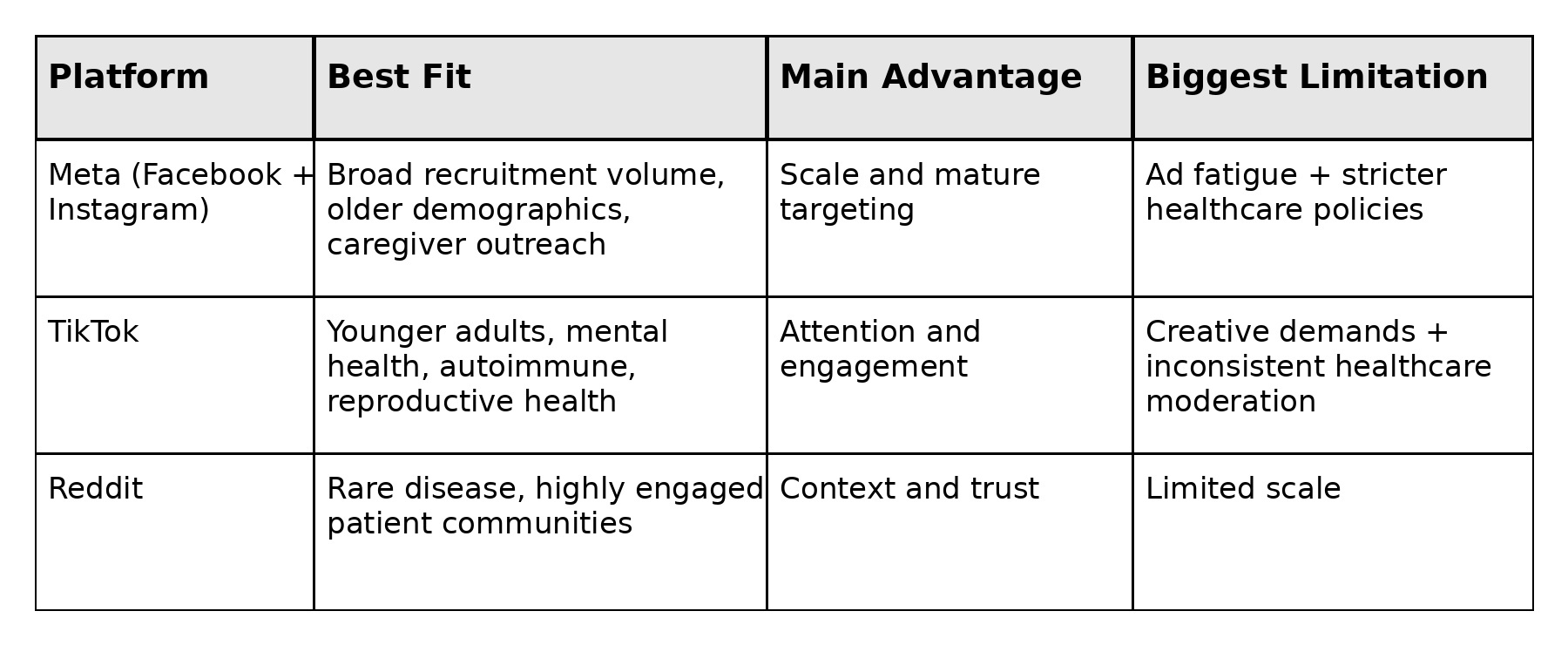
Meta still dominates for scale. TikTok is becoming important for awareness and younger demographics. Reddit remains one of the most underused channels for high-intent patient communities.
But none of them work well with generic advertisements copied across platforms.
The study teams getting strong patient recruitment performance in 2026 are treating each social media platform differently, because patients use each platform differently.